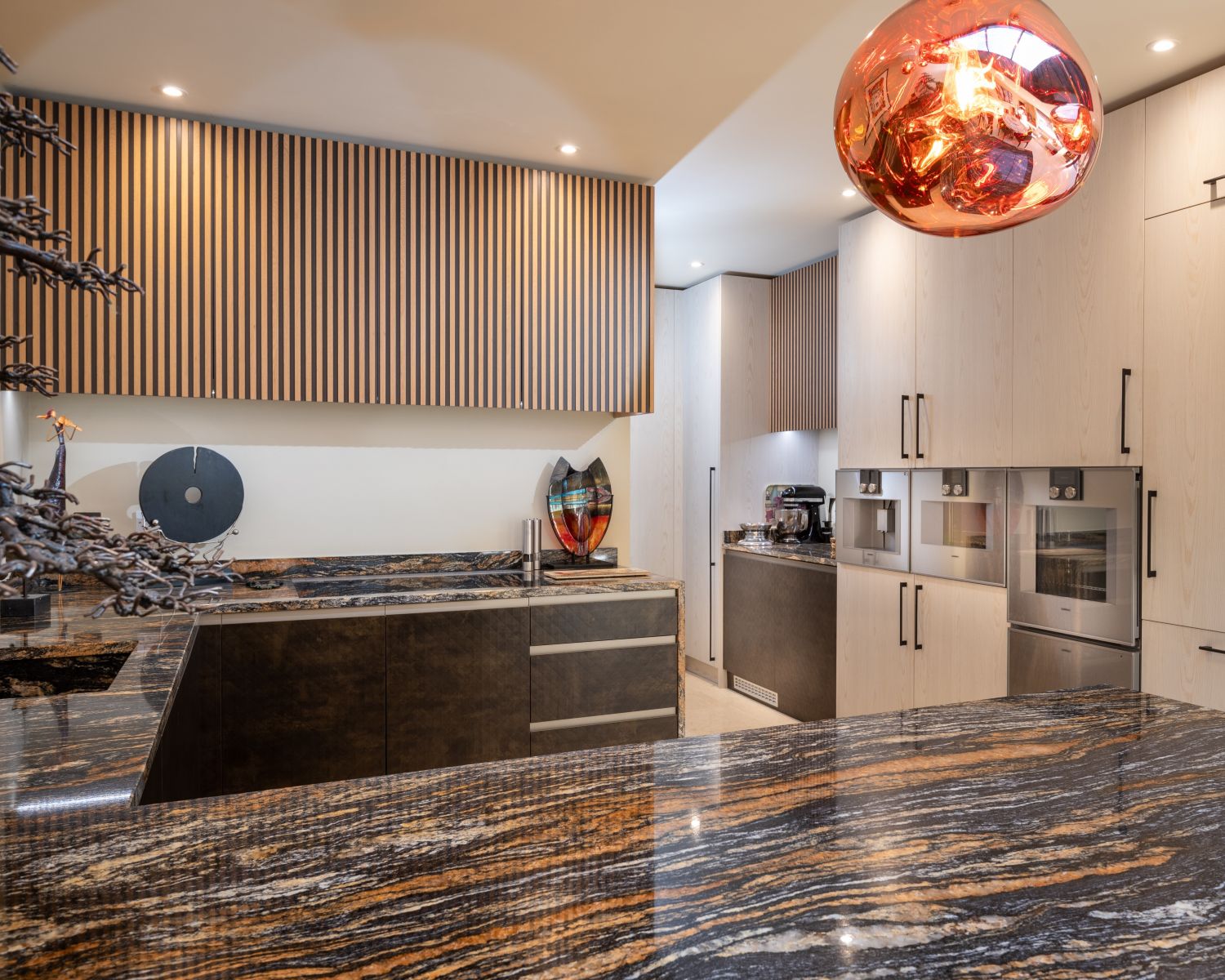
Contemporary kitchen design brings new life to historic toll house
Prestige Interior Projects has transformed a private residence featuring a historic toll house, creating a bespoke kitchen that balances heritage and modern style. Using Cleaf melamine finishes, the design bridges contrasting client preferences while complementing existing stone surfaces.
Bridging heritage and modern living
When Prestige Interior Projects was asked to renovate a private home incorporating a historic octagonal toll house, the project presented an unusual design challenge. The kitchen had to feel at home in a modern extension while respecting the character of the original building.
Director Bradley Jeffries worked closely with James Latham to specify two complementary Cleaf melamine finishes: Azimut (S022 Portland) for the tall units and Cheope (FB49 Glauco) for the base units. The combination achieved a balance between light and dark tones while harmonising with the home’s premium stone surfaces.ng client preferences
The clients had opposing aesthetic tastes: one preferred darker cabinetry, the other lighter tones. Adding to the complexity, the kitchen zone has no direct window despite being part of a bright open-plan space.
The design needed to create a sense of openness while remaining sensitive to the historic toll house. The dual-colour approach allowed the kitchen to satisfy both clients’ preferences while maintaining cohesion with the rest of the home.
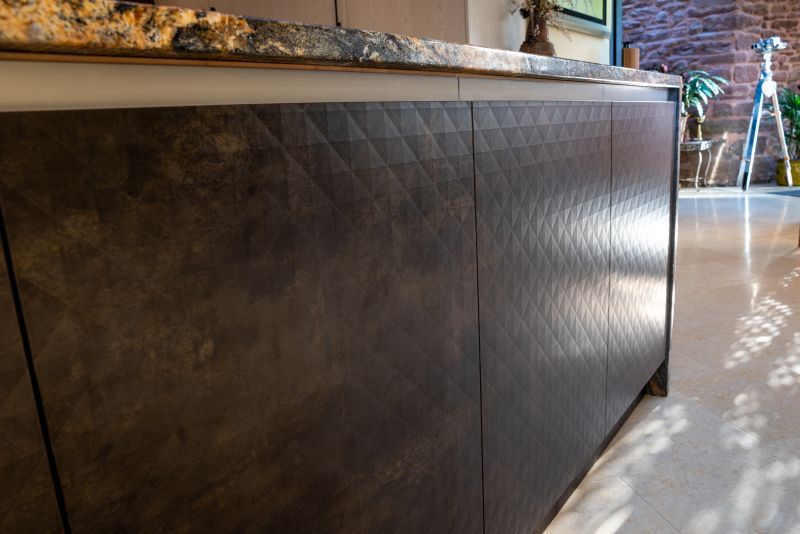
“The diamonds in the FB49 complement that odd octagonal shape of the old toll house,” says Jeffrey. “It’s a subtle detail that pulls the historic building into the new extension.”
Why Cleaf melamine was the right choice
Jeffrey specified Cleaf Azimut (S022 Portland) for tall units, providing a light timber finish with natural grain, and Cleaf Cheope (FB49 Glauco) for base units, featuring a darker, diamond-patterned panel.
Beyond aesthetics, the boards delivered technical advantages during fabrication. Jeffries notes: “It’s a very strong, solid material. It’s heavier than some of the more recognised melamine brands and, crucially, it stays straight when cut.”
Unlike lower-cost melamine, Cleaf panels retain their shape during machining, producing cleaner lines and a premium finish. Their textured surfaces also add depth, catching and reflecting light across the grain.
Precision grain matching for a bespoke finish
The project required multiple cabinetry runs longer than a single sheet. Jeffrey successfully grain-matched both the Portland timber effect and Glauco diamond pattern vertically and horizontally across doors made from multiple panels.
This attention to detail enhances the bespoke quality of the kitchen and reinforces the craftsmanship for which Prestige Interior Projects is known.
A 12-month journey to completion
From initial discussions to installation, the project spanned approximately 12 months. This allowed the team to develop the design fully, source premium Cleaf materials through James Latham, and deliver an installation with meticulous attention to detail.
The result is a kitchen that bridges historic architecture and contemporary design, balancing light and dark, heritage and modernity, while complementing the home’s stone surfaces.
Looking ahead: Cleaf for high-end projects
Based on the success of this project, Jeffrey now recommends Cleaf for all visible furniture and display applications. “I’d always offer Cleaf for anything that’s on show. It’s a premium brand product, slightly more expensive than the alternatives, but the quality justifies it. For high-end projects where clients want furniture that lasts, it’s the right choice.”